

Midway through the first stretch of Chup Raho, Rameen tells her mother what her brother-in-law has done to her, and her mother’s answer is to ask her to keep it to herself so that her sister’s marriage survives. Sajal Aly played the scene without the usual apparatus of television grief, no wail and no collapse, only a young woman absorbing the fact that her family had chosen the house over her. That stillness announced something about the actor that has held for more than a decade.
Sajal Aly was born in Lahore in 1994 and, as she told Sumaira Jajja in a 2017 Dawn Icon interview, started out as a promotions girl at a mall, taking work that supported her family before television found her. Her first substantial role came in the ARY soap Mehmoodabad Ki Malkain in 2011. She has since won the Hum Award for best actress several times and crossed into Hindi cinema opposite Sridevi in Mom (2017) and into English with Shekhar Kapur’s What’s Love Got to Do with It? (2023).
Read as a body of work, the Sajal Aly dramas that last share a type: women whose resistance is slow and costly, pushing against a family or a village from inside it. Her weaker work comes when a script asks her to be an ideal of romance or a draw for a big banner. That pattern explains both her best performance, in Aangan, and her most criticised recent choice.
Chup Raho and the early survivor roles
Between 2011 and 2015 she appeared in more than twenty serials, and the ones that mattered placed her inside a household that was failing her. Nanhi (Geo, 2013, directed by Haseeb Hassan) brought her first Lux Style nomination, and Sannata (ARY, 2013) paired her with Kashif Nisar, whose patience with domestic pressure, discussed in our piece on Kashif Nisar’s dramas, suited her.
Chup Raho (ARY Digital, 2014–15), written by Samira Fazal and directed by Yasir Nawaz, is still called her breakthrough. Reviewing it for Dawn in March 2015, Sadaf Haider argued that the serial made the case that there is no honour in silence, which is the right reading of its first half. The second half is harder to defend: a trafficking subplot and a villain who conveniently goes mad turned a story about complicity into one about luck, and the role drifted toward the bechargi that drama too often sells as sympathy. That Aly kept Rameen watchful rather than merely wounded is why the serial is remembered for her and not its plot.
Romance and the Farhat Ishtiaq years
Yakeen Ka Safar (Hum TV, 2017), adapted by Farhat Ishtiaq from her own novel and directed by Shahzad Kashmiri, cast her as Dr Zubiya, whose mother has been killed by her father, opposite Ahad Raza Mir, and won her the popular best actress prize at the 2018 Hum Awards. The same year’s O Rangreza, opposite Bilal Abbas Khan, gave her Sassi, a brash, headstrong heroine she named to Jajja as her favourite role because it forced her to open up emotionally. Sassi is the outlier in her filmography, and the jury prize it earned her suggested the industry noticed the stretch.
The weaker side showed in Yeh Dil Mera (2019), her second Ishtiaq serial with Mir, where a revenge thriller kept her reacting to a man’s secret for most of its length. The refusal to perform pain that made Rameen frightening reads as passivity when there is nothing to resist except a love story. Her work with Ishtiaq, whose wider career is traced in our guide to Farhat Ishtiaq’s dramas, is consistently polished and rarely her most interesting.
Aangan and the best performance of her career
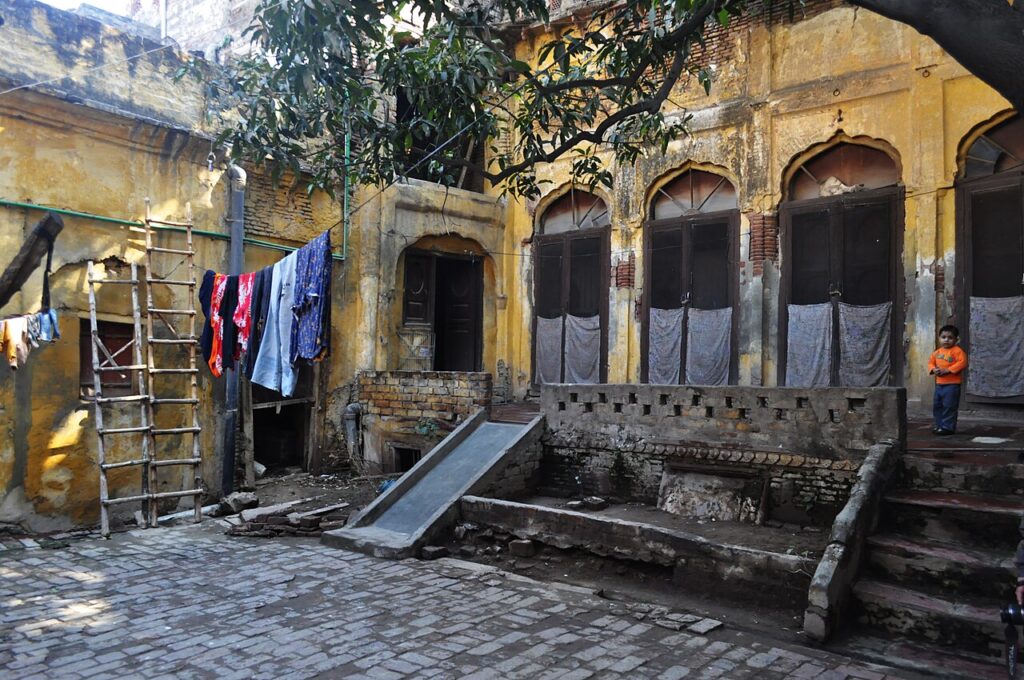
Aangan aired on Hum TV on Thursday nights from December 2018 to June 2019, 27 episodes adapted by Mustafa Afridi from Khadija Mastoor’s 1962 novel and directed by Mohammed Ehteshamuddin. Mastoor’s novel sees the Partition years from inside the women’s quarters, where politics arrives as rumour and men’s decisions land on people never consulted. Aly played Chammi, an abandoned relative in the ancestral haveli, attached for years to her cousin Jameel while he flirts with her and then turns to Aaliya.
The performance works because Chammi is allowed to be unattractive in the moral sense: jealous, stubborn, humiliating herself and aware of it. Aly plays her with a wary, defensive physicality, as though Chammi always expects to be asked to leave the room. Dawn Images placed it among the best television performances of 2019, and it remains the clearest case for her as a character actor. The ending is less convincing. After Chammi leaves an abusive marriage and returns, Jameel, moved by her devotion, proposes, turning years of humiliation into a romantic reward that flatters the love story more than the woman and sits awkwardly in a serial about how little the courtyard’s women get to choose.
Alif, Sinf-e-Aahan and the prestige-project problem
After Aangan, Aly moved into large, carefully marketed projects. Alif (Geo, 2019), Umera Ahmed’s spiritual drama directed by Haseeb Hassan, cast her as the film actor Momina Sultan opposite Hamza Ali Abbasi, and Sinf-e-Aahan (ARY, 2021–22), directed by Nadeem Baig, placed her among five young women joining the army, an ensemble whose appeal Miysha Usman set out in her reasons to watch Sinf-e-Aahan. Both earned her Lux Style nominations and both are worth watching, but in each she is one element of a message rather than the centre of a story, and her particular gift gets less room. Ishq-e-Laa (2021), in which her character left after eight episodes, was a more awkward case. None of these is a poor performance, yet together they show an actor being used for her name at a stage when she could carry harder material.
Kuch Ankahi and Zard Patton Ka Bunn: range, then depth
Kuch Ankahi (ARY, January to July 2023), written by Syed Mohammad Ahmed and directed by Nadeem Baig, was the corrective. As Aaliya, a middle-class estate agent supporting her family and trying to buy back its home, Aly finally played comedy at length, sparring with Bilal Abbas Khan’s rival agent with a dry timing her earlier roles never asked for. The News International found the serial’s picture of the property business unrealistic, which is fair, but the performance proved that her restraint could be funny as well as tragic.
Zard Patton Ka Bunn (Hum TV, 2024), made with the Kashf Foundation, reunited her with Mustafa Afridi under director Saife Hassan. Meenu wants to become the first doctor from her village, and the serial threads her ambition through child labour and overpopulation. Reviewing it for Images in November 2024, Sana Hussain called it a story that comes along once in a long while and singled out only one flaw, Aly’s accent drifting away from the regional speech the character would use. That flaw matters more than the review allowed, since a village heroine who sounds urban weakens the serial’s claim to authenticity, and a finale in which Meenu graduates with eighteen gold medals tips hard-won progress into wish fulfilment. Even so, it is the strongest case for her since Aangan, and it won her both the jury and popular best actress prizes at the 10th Hum Awards. Its title song, “Teri Arzoo”, is sung by Zaw Ali and Sohail Shehzad.
Main Manto Nahi Hoon and the cost of a big banner
The pattern broke badly in 2025. Main Manto Nahi Hoon (ARY Digital, July to November 2025), written by Khalil-ur-Rehman Qamar and directed by Nadeem Baig, was produced by Humayun Saeed’s Six Sigma Plus. Aly played Mehmal Amritsari, a student from a Lahore gangster family who falls for her economics professor, played by Saeed. The romance drew sustained criticism, and in July 2025 Images objected to a fat-shaming classroom joke delivered by her character, noting that fans had long defended her as an actor drawn to strong female roles. Sanam Saeed later told Images that the cast, Aly included, had reworked some lines, which suggests the problem was visible on set.
The title borrows the name of a writer who put women’s choices on the page with uncomfortable honesty, yet the serial offered the most conventional gender politics in Aly’s recent work. Her reputation for serious roles lent it a credibility its script had not earned, which is partly why so much of the backlash landed on her as well as on its writer.
What her career asks of writers
Her latest serial, Zanjeerain, which premiered on Hum TV on 29 April 2026, returns her to Farhat Ishtiaq and Shahzad Kashmiri, with Aly as Rabia, who runs a dhaba with her brother and is caught in a feud between powerful families. The setup at least gives her a working woman with a place of her own rather than a heroine waiting in someone else’s house; the wider tradition she belongs to is surveyed in our list of iconic female roles in Pakistani dramas.
Across fifteen years, the serials that hold up are those where a writer trusted her with an inner life that runs ahead of the plot, as Mustafa Afridi has twice; the ones that fade gave her a love story or a cause to stand beside. For a viewer coming to her fresh, Aangan and Zard Patton Ka Bunn are the essential pair, with Chup Raho‘s first half and Kuch Ankahi showing the range in between, and I would leave the prestige projects for later. She is at her strongest when she follows writers rather than banners, and her choices after Main Manto Nahi Hoon will show whether she and the producers who cast her have taken that lesson.
Where to watch: Zard Patton Ka Bunn and Zanjeerain are on HUM TV’s official YouTube channel; Kuch Ankahi and Main Manto Nahi Hoon are on ARY Digital’s.


.jpg)
.jpg)