

The video for Rangeen opens on a Lahore rooftop during Basant. Hasan Raheem plays a young man who glimpses a girl across the rooftops and builds an entire romance around her in his head, in a pastel city full of cassettes, CDs and old film posters, until the daydream ends at her wedding to someone else and a shehnai carries the procession. The heartbreak is played for warmth rather than tragedy, and that lightness is a large part of the song’s appeal.
Rangeen was released on 18 September 2026 as the second song from Coke Studio Nu.WAV, the franchise’s new artist-led platform. Three weeks later, on 11 October, Raheem posted a clip of himself dancing to it in New York with a crowd joining in, and the song has since been travelling the way Pakistani pop now tends to travel, through short clips on Instagram and TikTok rather than through radio or television.
The song is the clearest case so far for what Nu.WAV is for: a compact, personal single shaped by a filmmaker’s eye, rather than the meeting of traditions that defined the main Coke Studio seasons. That same quality is also its limit. Rangeen is very much a Hasan Raheem song, built on a persona his audience already knows, and it asks less of its collaborators and its listeners than the best Coke Studio work has done.
What Coke Studio Nu.WAV is, and how it differs from the main seasons
Coke Studio Pakistan began in 2008 as a studio-performance show in which a house band brought folk, qawwali and classical musicians together with pop singers, and for most of its life its seasons were judged on those encounters. Season 14, produced by Zulfiqar Jabbar Khan (Xulfi) and released on YouTube between January and March 2022, broke with the episodic format and presented each song with its own music video. Among the directors that year was Kamal Khan, and it is Kamal Khan who created Nu.WAV.
When Coke Studio announced the platform in August, The Express Tribune reported that it would combine music with design, visual storytelling and film, and that artists would build their own creative worlds instead of fitting into the established Coke Studio sound. Coke Studio’s general manager, Sami Wahid, summed up the idea by saying that “each song has its own world.” The first edition was announced as six songs, and the opener, Dil, by Afusic, Ali Soomro and Zoha Waseem, arrived in early September to what the Tribune described as a mixed reception, with much of the argument turning on whether Nu.WAV should be judged on its own terms or against its parent show.
Who made Rangeen
The credits are worth setting out, because they explain the song’s character. Hasan Raheem wrote the lyrics and composed and arranged the vocals. The producer Umair, born in Karachi and credited with more than 150 releases, composed, produced and mixed the track and co-arranged it with Raheem; the two had already worked together on Radha, OBVIOUS and MAKE YOU MINE. Izzchugtai, a Lahore producer and performer known for Ghuroor and Nadiyan Paar, is the featured artist. Muhammad Salim plays the shehnai, Sean Tallman mastered the track, and Kamal Khan is executive producer.
The video was directed and edited by Arham Ikram for Gali Films, produced by Iman Khan, shot by Aamir Mughal and designed by Hashim Ali, with Sukaina Zaidi as the girl on the rooftop. Images noted the early-2000s detail of the sets, a decade that Pakistani pop audiences now look back on with real affection, as CurryFlow’s piece on the one-hit wonders of 2000s Pakistani pop suggests.
Why Rangeen is spreading
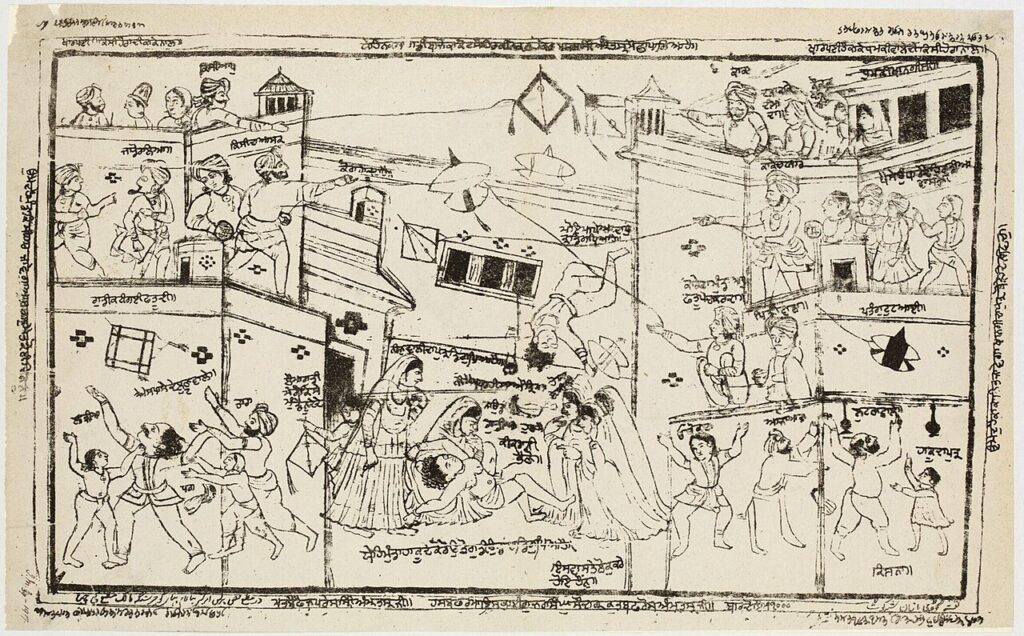
Part of the answer is the setting. Basant is one of the most loaded images available to a Lahore storyteller, a festival that has been argued over for years, as CurryFlow noted in 2017 in a piece on the movement to restore Basant. Kite-flying on Lahore’s rooftops was a subject for local woodcut artists as far back as the 1870s, and John Lockwood Kipling, who later ran Lahore’s art school and museum and became the model for the curator in his son’s novel Kim, collected prints like the one above. Rangeen uses that inheritance lightly, as a backdrop of colour and longing rather than a statement, which makes it easy to share and hard to argue with.
The other part is Raheem himself. His videos have long made room for the loose, Gilgiti-inspired dancing that fans imitate, and Images reported that an Instagram clip of him dancing with Sukaina Zaidi circulated alongside the release. Fans also seized on the fact that he is once again dressed as a dulha, joking about his earlier MEMORIES campaign, when some followers believed he had actually married. The New York clip, which 24 News reported on 11 October, fits the same pattern: Raheem in a leather jacket, a public crowd, and a song simple enough for strangers to join. In a market where songs now spread through repeatable fifteen-second moments, an artist whose physical presence is part of the music has a clear advantage.
Where Rangeen sits in Hasan Raheem’s career
Raheem was born in Gilgit in 1997 and began releasing singles in 2018 while studying medicine in Karachi. Aisay Kaisay, released in January 2020, made his name, and Joona, made with Abdullah Kasumbi, followed. Reviewing Joona for Dawn’s Icon in January 2021, the columnist Band Baji described his vocals as low-key and relaxed and noted a short passage in Shina, his first language. That combination of an unhurried voice and a regional signature has stayed with him. Unlike singers who reached a mass audience through drama soundtracks, the route that made composers such as Sahir Ali Bagga household names, Raheem built his following through independent singles and streaming.
His Coke Studio debut came with Peechay Hutt in Season 14, released on 19 February 2022 with Justin Bibis and Talal Qureshi, a multilingual track in English, Urdu and Shina that later played over the end credits of Marvel’s Ms. Marvel. Since then he has released the album Nautanki (2022), the EP Maybe, It’s Love (2023), which included Wishes, and the album Dil Kay Parday (2025). Rangeen brings him back to Coke Studio more than four years after Peechay Hutt, but on very different terms: Peechay Hutt was a three-way collaboration built inside Xulfi’s production, while Rangeen is effectively a Hasan Raheem single made with his regular producer under the Nu.WAV banner.
What works in Rangeen, and what it leaves out

The strengths are real. Rangeen is economical, at a little under four minutes, and it knows exactly what it wants to be: a bittersweet romance with a smile at the end. The partnership with Umair gives Raheem a sound he is comfortable in, and the video’s team, from Arham Ikram’s direction to Hashim Ali’s period sets, treats a three-minute daydream with the seriousness of a short film. As a demonstration of Nu.WAV’s promise that each artist can build a world, it succeeds.
The weaknesses come from the same place. The traditional element that once gave Coke Studio its purpose is present here mainly as a cue: in the video, the shehnai arrives with the wedding, signalling the end of the fantasy rather than shaping the song. Izzchugtai is credited as a featured artist, but the lyrics and vocal composition are Raheem’s, so the collaboration reads more as a guest appearance than a meeting of two artists. The groom’s costume, which fans have already noticed, suggests a persona at some risk of repeating itself. None of this spoils the song, but it does sharpen the question the Dil debate raised, which is what distinguishes a Nu.WAV release from a well-funded label single.
Where to listen: Rangeen (Coke Studio Nu.WAV) is on Coke Studio’s official digital platforms, including Spotify and Apple Music.
A good single, and a test still to come for Nu.WAV
Rangeen deserves its success. It is warm, well made and honest about its own scale, and it shows why an artist with Raheem’s ease in front of a camera suits a platform built around film as much as sound. The song’s spread owes as much to that presence, and to a video designed for repeat viewing, as to anything new in the music, and there is nothing wrong with that. Pop has always travelled on images as well as melodies, and few current Pakistani artists understand that better than he does.
The larger test belongs to Nu.WAV. With Asim Azhar’s Maheya already out and Young Stunners, Maanu and Shae Gill still to come, the platform has room to show that artistic freedom can produce risk as well as polish. Rangeen proves the format can make a likeable, widely shared single. Whether it can also make the kind of song that changes what listeners expect from Coke Studio, as the best of the main seasons did, will depend on the artists who follow Raheem being willing to leave their comfort zones in a way he did not need to here.


